
A coating forms a film on concrete; hydrophobic impregnation penetrates the pores and makes their walls water-repellent. Both can limit moisture or aggressive-agent ingress, but work differently and do not automatically solve an existing structural or corrosion problem. Selection depends on exposure, surface, moisture, cracks, desired vapour movement, traffic and maintenance. [1, 2]
Two systems, different functions
- Hydrophobic impregnation, often based on silane or siloxane, penetrates the surface and reduces liquid-water uptake. It does not usually form a visible continuous film. Penetration depth, substrate condition and drainage affect performance. Cerema identifies limits for carbonation protection and for permanently wet or poorly drained areas. [1]
- Film-forming coating creates a layer over the concrete. Depending on the system, it may limit water, chlorides, water vapour or carbon dioxide. A film can wear, become damaged or debond; moisture behind it, cracks, roughness and edge/junction details need attention. Traffic adds abrasion and skid-resistance considerations. [1, 2]
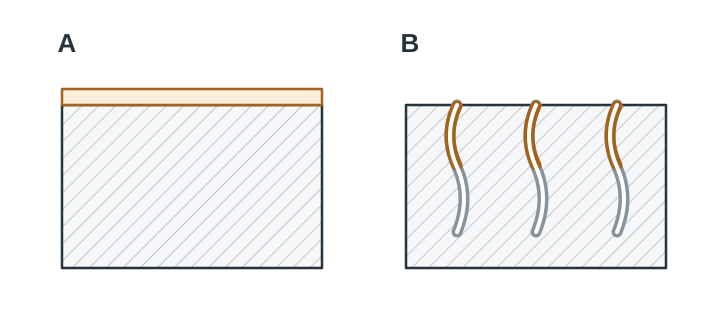 A shows a surface film; B shows impregnation in pores. Schematic, not to scale and not a product cross-section.
How do you choose?
First identify deterioration mechanisms and required performance. A penetrating water repellent may suit limiting liquid water and chloride ingress from the treated face, but is not an automatic solution for carbonation or leakage through a through-crack. A coating may provide a broader barrier or traffic-bearing protection, but needs a compatible, adequately prepared substrate and attention to edge details, vapour transport, bond and wear. A combined system may suit some conditions; its layers need to be designed to work together. [1, 2]
Do not cover active leakage or loose concrete with a protective layer alone. Assess existing chlorides, corrosion, moisture source and drainage. Product-specific application conditions, layer build-up, preparation and curing depend on the project design and selected system instructions.
Application and checks
Specify how the surface will be cleaned and prepared, which cracks and details will be treated separately, how materials and conditions will be recorded and which acceptance checks apply. Possible checks include visual inspection, thickness or adhesion checks and a trial area; appropriate checks and acceptance criteria are project-specific. During service, inspect for damage, wear, blistering, debonding and leakage at joints. Inspection can identify maintenance needs but does not itself prove protection throughout the concrete volume.
Ask why the system suits the mechanism, which alternatives were considered, how substrate and moisture conditions will be accepted, and how details and future inspection will be handled. See reinforcement corrosion, chlorides in concrete and concrete condition assessment.
Sources
- Cerema, Protection des bétons, aide-mémoire sheet, February 2021, p. 6: applications and limitations of hydrophobic impregnation, coating and duplex systems; substrate and drainage conditions. Fact sheet PDF.
- FHWA, Current Information on the Use of Overlays and Sealers, FHWA-HRT-16-079, 2017, “Sealers for Concrete Bridge Decks”: penetrating versus film-forming sealers and limits such as penetration depth, skid resistance and traffic wear. US bridge-deck context. Report.