
Chlorides can enter concrete from de-icing salts, seawater or salt spray. They may also be present in the original constituents. A chloride test on powder or a core sample describes the amount in the material sampled; samples from different depths can form a profile. No single result is a universal corrosion threshold or complete diagnosis. [1, 2]
Where can chlorides enter?
For existing structures, repeated wetting with de-icing salts, seawater and splash zones are possible external sources. Salts can also enter through cracks, joints, leaking connections or local water paths. Distribution need not decrease uniformly with distance from the surface. A bridge area below a leaking joint, for example, may have a different profile from a sheltered face. [1]
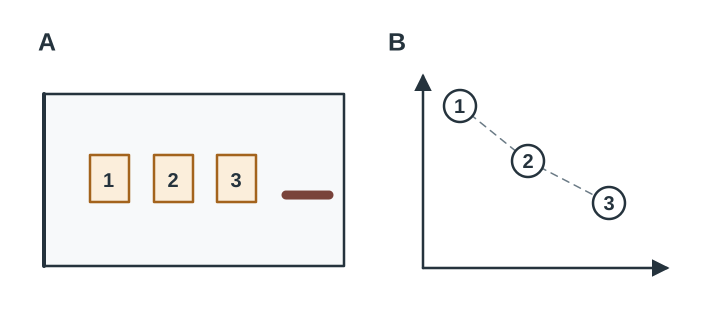 A shows three separate depth intervals from the exposed face at left. B shows an illustrative profile with depth on the horizontal axis and chloride content on the vertical axis.
What does a depth profile show?
A laboratory can determine chloride content in drilled powder or core material. For a profile, samples from selected depth intervals are collected and analysed separately. The report can then show how measured concentration varies at that location. It should state sampled depths, test method, reporting basis and sampling locations. FHWA describes both acid-soluble and water-soluble methods in a bridge context; results are not interchangeable without explanation. [1]
A profile near a crack, joint or leak may differ from one on a dry face. Multiple locations help identify spatial variation but remain samples. A profile also does not directly show whether corrosion is currently active, how much steel has been lost or which repair should be selected.
How should results be used?
Ask the specialist to relate measured values to reinforcement position, concrete cover, moisture, visible corrosion signs and the decision to be made. A concentration cannot be interpreted apart from test method, units and material basis. Do not use a general threshold from another standard, country or fresh concrete mixture as an automatic decision rule for existing concrete. [1, 3]
Ask where and at what depths drilling was done, how cross-contamination was controlled, which chloride fraction was measured and how variation was treated. If the question also concerns carbonation, delamination or corrosion activity, additional methods are needed.
See reinforcement corrosion, concrete carbonation and concrete condition assessment.
Sources
- FHWA, Foundation Reuse for Highway Bridges, 2018, “Chloride Ingress”, p. 132: powder samples by location and depth, chloride profiles and acid-/water-soluble methods. PDF.
- FHWA, Long-Term Bridge Performance Program Protocols, version 1, January 2016, Fld-Dc-Ms-004, §§3.2–3.4: core preparation, depth increments, analysis and reporting of chloride profiles. US bridge protocol, not a universal sampling specification. Protocol.
- Cerema, Guide de l'inspection du génie civil, chapter 10, §10.6.3, p. 93: core tests including carbonation and chloride profiles; surface tests as indicative and comparative. PDF.