
Reinforcement corrosion may show as rust staining, cracks above bars, hollow areas and spalling. These signs warrant investigation, but do not by themselves establish whether steel is actively corroding, how much cross-section has been lost or what repair is needed. [1, 2]
Why steel in concrete can corrode
In sound concrete, alkaline pore solution helps maintain a protective layer on steel. Carbonation lowers alkalinity; chlorides can locally disrupt the passive layer. Moisture and oxygen influence the corrosion process. Corrosion products occupy more volume than the original steel and can press against surrounding cover, potentially causing cracks and spalling. Carbonation and chlorides may occur together. [1]
What to record
Record the location and pattern of cracks, rust staining, moisture, spalling and visible reinforcement. Photograph the whole element and details with a scale reference. Note previous repairs and known exposure to de-icing salts or seawater. These observations help focus an investigation, but rust colour can have another source and corrosion may remain hidden.
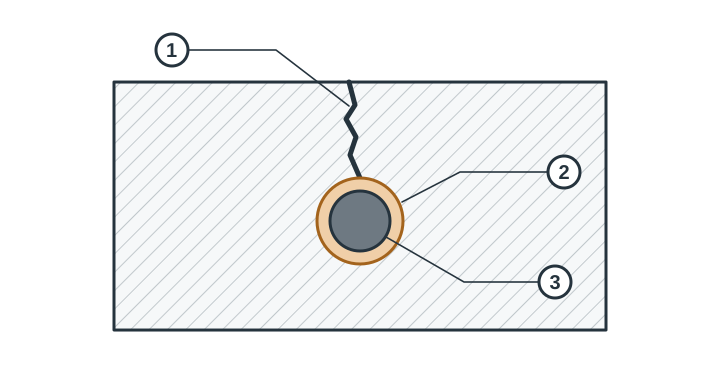 One possible cover crack. 1. Crack. 2. Corrosion products. 3. Reinforcing bar in cross-section.
Which investigations add evidence?
Inspection may use visual survey and sounding to locate suspect areas. Suitable electromagnetic equipment can investigate cover and bar position. Carbonation depth is often explored on a fresh fracture or core using a pH indicator; this is a local indication, not a corrosion-rate measurement. Chlorides are commonly measured in drilled powder or core samples; samples at successive depths can form a profile. Half-cell potential mapping can indicate where active corrosion is more likely. It does not measure the rate or the loss of steel section. Interpretation depends on test conditions, electrical continuity and supporting evidence. [2, 3]
The combination of inspection, selected reinforcement exposure and laboratory or field measurements should match the structure and the question. One number or test does not give a complete picture of cause, rate, remaining bar section and structural significance.
When to seek specialist assessment
Have growing cracks, recurring spalls, exposed or visibly deteriorated reinforcement, and damage to load-bearing or prestressed members assessed. A structural engineer determines whether section, anchorage or load capacity is affected; a durability specialist can help establish exposure and corrosion mechanisms. Repair should not mean simply closing the visible spot: the extent of deterioration and repair objective need to be supported.
Ask which evidence supports the diagnosis, which alternatives were considered, how bar section and chloride/carbonation are investigated, and how the result will be checked. See concrete carbonation, chlorides in concrete and concrete condition assessment.
Sources
- FHWA, Guidelines for Detection, Analysis, and Treatment of Materials-Related Distress in Concrete Pavements, FHWA-RD-01-163, March 2002, chapter 3 and appendix A: corrosion indicators, carbonation and chlorides, moisture/oxygen and expansive corrosion products. Pavement context; not used as a universal threshold rule. Chapter 3 · Appendix A.
- FHWA, Foundation Reuse for Highway Bridges, 2018, durability assessment chapter, p. 132: chloride profiles from depth samples and phenolphthalein for indicative carbonation depth. PDF.
- FHWA, Half-Cell Potential Testing, LTBP FLD-DC-NDE-003, §§6.1–6.6. Protocol.