
Shotcrete is a cementitious mixture pneumatically placed onto a prepared surface. It can suit larger vertical or overhead repair areas where formwork is difficult or material must be placed around reinforcement. Choosing shotcrete does not, by itself, correct a structural deficiency: the cause, extent and repair objective must first be established. [1, 2]
When is shotcrete an option?
Shotcrete may be considered for walls, columns, beam sides, soffits and bridge elements. It is also used to restore cover or as part of structural repair. That use requires a design addressing removal, reinforcement, layer build-up and the connection to existing concrete. Hand-applied mortar may be simpler for a small, accessible area; form-and-pour may offer more control in a deep void or complex shape. None of these methods is universally suitable. [1, 2]
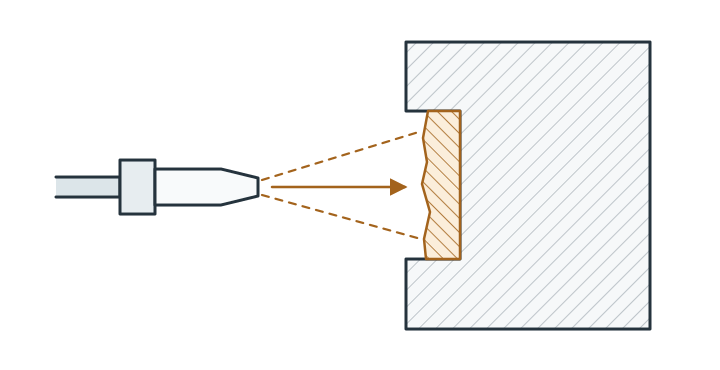 Shotcrete is placed onto a prepared vertical repair area; schematic illustration, not a construction detail.
What affects quality?
- Assessment and boundaries. Map the damage and likely cause. Remove concrete that is unsound or unsuitable. Repair boundaries and any saw cuts follow the project instructions; deep cutting without locating reinforcement can damage steel.
- Substrate and reinforcement. Leave a clean, sound substrate in the moisture condition required by the specification. If bars are exposed, the design determines whether cleaning, supplementing or replacement is needed. Allow enough clearance around steel for shotcrete placement.
- Process selection. Wet-mix and dry-mix differ in where water is introduced and how the material is conveyed. Selection depends on access, material, required output, equipment and crew competence. A qualified shotcrete team controls the setup and application.
- Layering and consolidation. The nozzle operator controls distance and angle, places material in manageable layers and watches for voids, rebound and shadowing behind reinforcement. Thickness, direction and sequence follow the design and material instructions.
- Finishing and curing. Remove loose or excess material, finish as specified and protect the repair from rapid drying and unsuitable conditions.
How is the result checked?
Record preparation, materials, crew, conditions and placement sequence. Visual inspection can reveal irregularities, rebound or visible cracking, but cannot confirm full bond or internal consolidation. The inspection and test plan may require test panels, cores or bond tests. Acceptance criteria should be project-specific and set by the designer. [1]
Ask in advance: which damage is being repaired; why is shotcrete suitable here; how will material reach behind reinforcement; who accepts the substrate; which mock-ups and checks are agreed; and what traffic, dust, fall and environmental controls apply?
See also concrete surface preparation, repair and protect reinforcement and form-and-pour repair.
Sources
- ACI Committee E706, Concrete Repair by Shotcrete Application, ACI RAP-12, 2010, pp. 4–6: suitable surfaces, preparation, wet- and dry-mix processes, placement and curing. A US field guide; project specifications and assessment remain necessary. PDF · ACI course description.
- Cerema, Béton projeté, practical factsheet, February 2021, especially pp. 3–11: preliminary assessment, suitable situations, corrosion diagnosis, preparation and application. French asset-management context; no generic project limits. PDF.