
In a formwork repair, flowable repair material is placed into the space between a prepared recess and a temporarily closed mold. It can suit larger or deeper voids, including areas around reinforcement where hand application is difficult. Pouring through an opening and pumping through a hose are different ways of filling that enclosed space; selection depends on geometry, material and access. [1, 2]
When does this approach fit?
Formwork holds the material in place and restores a profile. Hand-applied mortar is often simpler for a small shallow area; shotcrete may suit a large vertical repair. Formed repairs depend on stable, well-fitted formwork, sound joints, planned feed and vent paths, and complete filling behind reinforcement. The design determines whether the repaired section must contribute structurally. [1]
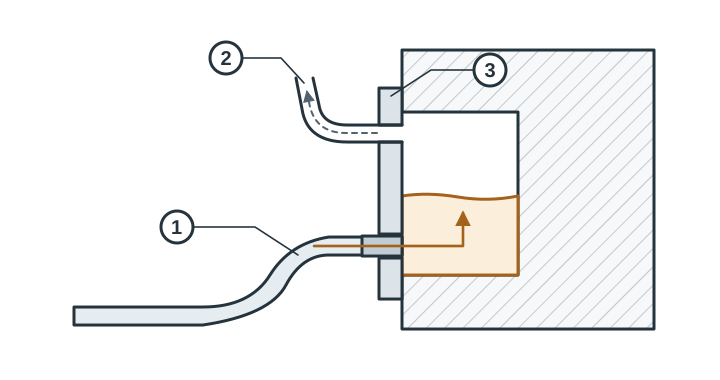 Schematic filling behind formwork. 1. Feed hose. 2. Vent. 3. Formwork.
How is placement prepared?
- Assess the cause, boundaries and extent of damage. Remove unsuitable concrete under the repair design and prepare the substrate and reinforcement.
- Select a pourable material whose workability and aggregate suit the available space, hose or feed opening, and cavity shape. Product instructions and design set the placement conditions.
- Build rigid, leak-tight formwork able to resist placement forces. Plan feed ports and high vents; check that space around bars remains accessible.
- Place material using the selected system. For pumping, connect the hose to the feed port and follow filling through designated vent or inspection ports. Improvised pressure or feed can cause leakage, segregation or incomplete filling.
- Remove forms only after the specified period and inspect the surface. Hidden voids require a verification method planned in advance.
What should be checked?
Record material batch, mixing, environment, placement sequence and interruptions. Check formwork and connections before placement; during the work, observe leakage and material appearing at inspection ports. These observations do not prove that the whole cavity is filled. Put acceptance criteria, additional tests and corrective actions in the project plan. [1]
Ask which feed method is used, how air escapes, how material reaches behind bars, which pressure and pump settings the product allows, and how hidden defects will be detected.
See also concrete patch repair and shotcrete repair.
Sources
- ACI Committee E706, Surface Repair Using Form-and-Pour Techniques, ACI RAP-4, 2003, reapproved 2009, pp. 3–7: purpose, preparation, formwork, material selection and placement. PDF · ACI publication page.
- ACI Committee E706, Surface Repair Using Form-and-Pump Techniques, ACI RAP-5, course overview: pumping repair material behind formwork. ACI University.