
Local concrete repair also requires assessment of any exposed reinforcement. Rust staining or a visible bar does not show how much steel section remains or whether the bar is adequately anchored. Repair boundaries, cleaning, any protective coating, and adding or replacing steel follow from the assessment and design. [1, 2]
What needs to be established first?
Investigate the cause and extent of damage, including possible carbonation or chlorides, moisture, corrosion distribution and the element’s function. Local repair may leave deterioration nearby; the transition between new and old concrete can change corrosion conditions. A broader repair strategy or additional corrosion mitigation may therefore be needed in some circumstances. [1]
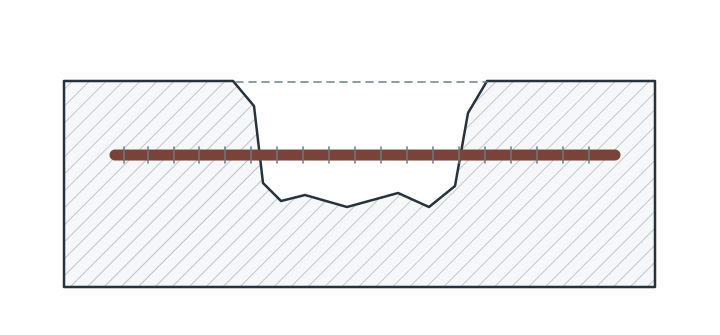 Continuous reinforcement exposed locally before reinstatement. The recess is open. The sketch specifies no dimensions or steel treatment.
Which actions belong in the plan?
- Remove concrete to the agreed boundary and assess the bar around its perimeter and along the affected length. Provide enough space around steel for the selected repair material.
- Have corrosion products and bond condition assessed. Cleaning may use selected mechanical or water-based methods. A protective coating is not automatically required and may affect bond or electrical behavior in some systems.
- If section loss is suspected, measure the remaining bar under a suitable plan. A structural engineer determines whether bars are adequate, need supplementing or replacement, and how forces are transferred.
- Place repair material to the design and product instructions, with adequate encapsulation and consolidation. Consider the possibility of continued corrosion outside the visible patch.
Inspection and handover
Record bar location, visible condition before and after cleaning, any added reinforcement, materials and deviations. Photographs support documentation but do not quantify steel loss. Any measurements, quality checks and acceptance criteria belong in the repair plan. Visual inspection of the repair cannot independently confirm remaining structural capacity.
Ask who assessed bar section, how the repair boundary was set, whether chlorides or carbonation near the repair were investigated, which corrosion strategy was selected and who accepts the structural implications.
See also concrete surface preparation, cathodic protection and concrete patch repair.
Sources
- ACI Committee 364, Concrete Removal in Repairs Involving Corroded Reinforcing Steel, ACI 364.6T-02(11), reapproved 2011, pp. 1–3: removal extent, exposing and cleaning steel, chlorides/carbonation and the ring/halo effect. Historical technical note; ACI’s publication page indicates a newer version exists. PDF · ACI publication page.
- ACI Committee E706, Spall Repair of Horizontal Concrete Surfaces, ACI RAP-7, 2010, pp. 3–5: exposing corroded bars, section loss and consulting a structural engineer. PDF.