
A first inspection helps you record visible features and choose an appropriate next step. A crack, discolouration, hollow-sounding area or spall is an observation; by itself it does not prove what caused the damage or whether a structure is safe. If load-carrying capacity or falling concrete is a concern, an expert assessment is needed. [1, 2]
What visible features can you look for?
Look for cracks, broken edges, flakes, blisters, rust-coloured staining, white deposits, damp patches, abrasion and exposed reinforcement. Record where each feature occurs: at an edge, soffit, column, balcony, floor or joint. A damp patch or rust stain may prompt further investigation of water paths and reinforcement, but is not a diagnosis on its own. Different causes can produce similar features. [1, 3]
The illustration shows only visible features that can be recorded during an initial walk-through. The crack and local material loss are not assigned a cause.
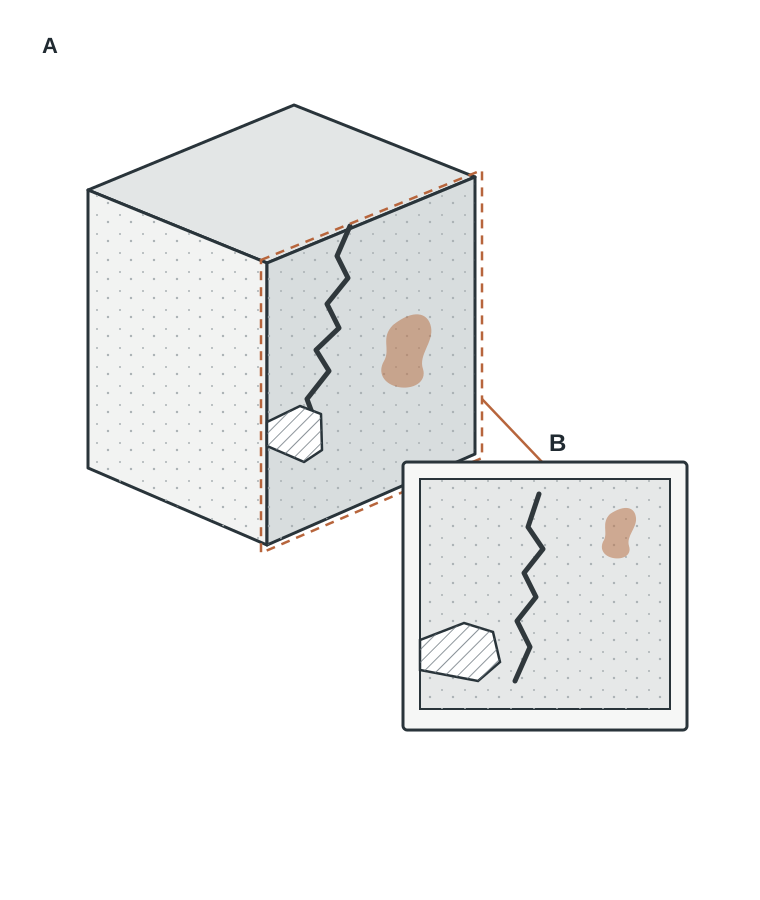
Figure 1. Schematic visual inspection. A shows features on the element; B is a surface detail, without a conclusion about cause. Not to scale.
Record the condition so it can be followed
Start with available drawings, maintenance and repair history, and reports from users. For each feature, record the element and exact location, date, visible shape, approximate extent and any relation to joints, edges, water or other features. Take an overview and a close-up with a scale reference. For later inspections, use the same viewpoint and similar photographic conditions. [1, 2]
Describe what you see in neutral terms: for example, “broken concrete, roughly rectangular, reinforcement visible” rather than assigning a cause such as reinforcement corrosion or freeze-thaw damage. Gentle sounding with an inspection hammer can help a qualified inspector locate possible delamination. The sound is not a complete quality or safety assessment; some damage may be hidden. Do not chip away concrete or enter a suspect area yourself to determine its extent. [1, 2]
When is further assessment needed?
A visual walk-through is a starting point. If the cause, extent or consequences are unclear, a concrete specialist or structural engineer may recommend a records review, targeted measurements, material testing or structural assessment. The choice depends on the question: for example, whether an area is delaminated, whether reinforcement is corroding, how deep deterioration extends, whether a crack is changing, or whether an element still performs its function. Different questions call for different tests. [1, 2]
Contact the owner or manager promptly if concrete may fall, damage worsens suddenly, a load-bearing element deforms unexpectedly, or there are signs of reduced load-carrying capacity. A first inspection cannot confirm structural safety. If there is an immediate danger, keep people away and ask the responsible manager to arrange appropriate assistance. [1]
What happens after the first assessment?
The next step may be documentation and monitoring, targeted investigation, maintenance or a designed repair. First clarify the objective: safety, serviceability, durability, watertightness or appearance. Then consider cause, extent, exposure, access and the intended service life. A local repair that leaves the relevant cause in place may fall short; conversely, repair is not automatically needed if it does not serve an agreed management objective. [3, 4]
See also cracks in concrete, concrete spalling and delamination and choosing a repair method. Ask the specialist which observations were directly established, which explanations remain hypotheses, what investigation could change the decision, and whether temporary measures are needed.
Sources
- ACI Committee 364, Guide for Assessment of Concrete Structures before Rehabilitation, ACI PRC-364.1-19, Chapters 3–8, especially §5.4 visual inspection, §5.6 unsafe or potentially hazardous conditions, and Chapters 6–8 on testing, evaluation and reporting. A guide for pre-rehabilitation assessment; not a substitute for local regulations or assessment of a specific structure. ACI publication.
- FHWA, Visual Inspection—Concrete Elements Protocols, FHWA-HRT-16-007 (2016), protocol FLD-DC-VIC-004, §§3–6: locating and recording spalls and delaminations, field observations and possible causes. A protocol for US bridges; its recording approach is informative and is not a local inspection standard. FHWA protocol.
- Betonvereniging, “Schademechanismen van beton”, overview of corrosion, alkali-silica reaction, freeze-thaw and mechanical deterioration, among other mechanisms. Article.
- Betonvereniging, “Voorkom zinloos onderhoud, kies voor onderhoud dat wel werkt”, on management objectives, causes, service life and comparing maintenance scenarios. Article.