Spalling is concrete that has detached from the surface; delamination is a separation between layers below the surface. A delaminated area may sound hollow or later fall away before steel is visible. Exposed reinforcement is a separate observation: cover is locally missing, but the appearance alone does not establish how much steel has corroded or why. [1, 2]
Three observations, not one diagnosis
- Delamination: a hidden plane where concrete layers no longer bond well. The surface may still look intact. An inspector may carefully sound suspected areas or use a suitable survey method; a hollow response is an indication, not a conclusive diagnosis.
- Spall: a piece has detached, leaving a depression or rough fracture edge. Record its location, length, width and, where possible, depth. Note whether it is near reinforcement, a joint, an edge or a water path.
- Exposed reinforcement: record whether the bar appears clean, stained, corroded, bent or damaged. A photograph cannot establish the remaining steel cross-section.
These conditions can be associated with corrosion, freeze-thaw, impact, overstress, material reactions or construction defects. Rust staining or a hollow sound does not prove a single cause. [1]
Observe and document safely
Keep clear of the fall zone of potentially loose concrete and do not touch loose pieces. If people may be at risk, the responsible asset manager should restrict access under the site procedure and arrange prompt expert assessment. From a safe position, take overview and detail photographs, record the element and orientation, mark the boundary on a sketch, and note moisture, rust staining, cracks and previous repairs. FHWA inspection protocols record location and dimensions and compare findings with earlier inspections. [1, 3]
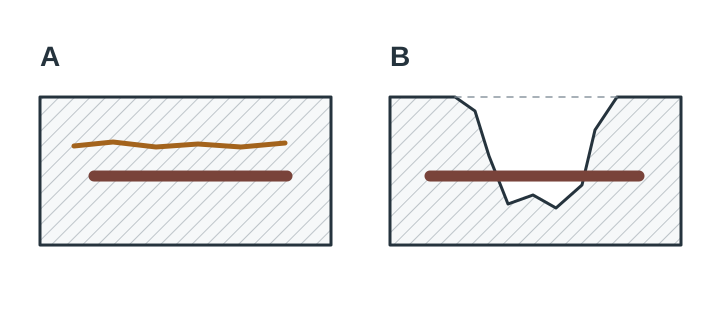 Schematic distinction: A shows a hidden layer separation; B shows material loss to the reinforcement. Not to scale.
How is the cause investigated?
Assessment may include visual inspection and systematic sounding or another suitable method to map hollow areas. If extent, depth or mechanism is unclear, a specialist may open selected areas, take samples or commission material testing. A visible-damage and delamination survey helps locate candidate areas but does not by itself prove active corrosion or freeze-thaw damage. [1, 2]
Where steel is exposed, cover, corrosion, possible pitting and cross-section matter. Assessing corrosion extent may require additional measurements and targeted exposure. A structural engineer or concrete-repair specialist should be involved where load capacity, prestressing steel, falling debris or progressive damage is a concern.
Next step
Ask which areas were examined, how their boundaries were established, what cause is suspected and what evidence could disprove that hypothesis. Before repair, ask how adjacent deterioration and reinforcement will be assessed. See reinforcement corrosion, concrete condition assessment and concrete patch repair.
Sources
- FHWA, Long-Term Bridge Performance Program Protocols, version 1, January 2016, Fld-Dc-Vic-004, §§3–6: definitions of spall/delamination, causes, locating and validating observations. US bridge inspection guidance, not a universal building standard. Protocol.
- FHWA, Tunnel Operations, Maintenance, Inspection, and Evaluation Manual, FHWA-HIF-15-005, chapter 4, pp. 4-43–4-44: delamination and hollow sound; spalling as material loss and recording dimensions and exposed reinforcement. PDF.
- UK Building Safety Regulator, “Preparing safety case reports: structural balconies”, accessed 10 November 2026, “Background and possible reasons” and “Short term responses”: specialist assessment and possible access restriction where concrete may fall. UK building context. Guidance.