
A seal can reduce water entry through an assessed nonstructural crack, or accommodate movement in a designed joint. These are different purposes and details. Rigid filling does not make a moving crack stable, and an elastic joint sealant does not restore structural continuity. First establish whether the feature is a crack or an intended movement joint, and determine its cause and movement. [1, 2]
Which approach fits which purpose?
- Surface sealing: a suitable liquid or paste sealer closes the visible crack mouth. It may suit a narrow, nonstructural crack when the aim is to limit ingress. It does not necessarily fill the full depth.
- Routing and flexible sealing: the crack is opened to a specified detail and filled with flexible sealant. This may reduce water entry in nonstructural cracks, but it does not transfer structural forces. [1]
- Joint sealing: a designed joint uses suitable backing and elastic sealant or another joint profile, selected for movement, substrate and exposure. Do not fill an existing movement joint with rigid material that prevents movement.
- Injection: may serve another purpose, including structural bonding or filling a water path. See crack injection for assessment and material selection.
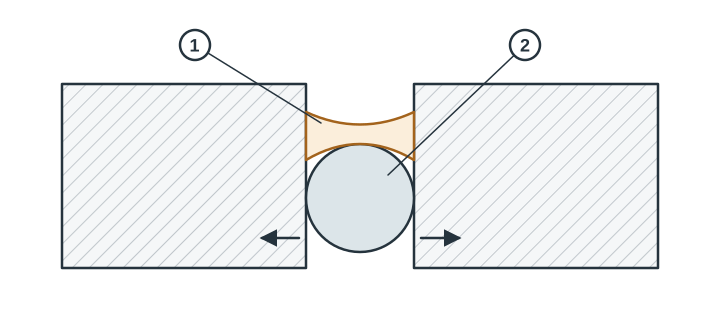 Elastic seal between concrete elements. 1. Sealant bonded to the joint sides. 2. Backing rod. Arrows show possible joint movement.
Preparation and inspection
Clean the sides as required by the selected system and remove loose material. For a joint, the detail specifies width, depth ratio, backing, primer and sealant. Follow product instructions and project details; do not infer these values from a generic illustration. Consider moisture, temperature, movement and access. Record the location and any leakage before work.
After curing, inspect visible continuity and contact. Visual inspection does not prove substrate bond or watertightness under all service conditions. Agree a check suited to the function in advance, such as a water test where safe and relevant, and record conditions and acceptance.
Ask whether the crack is active, whether the detail must accommodate movement, how much of the section is sealed, how bond to the sides is achieved and how the result will be assessed. Have structural cracks assessed first.
See also cracks in concrete, crack injection and choosing a repair method.
Sources
- FHWA, Underwater Bridge Repair, Rehabilitation, and Countermeasures Reference Manual, FHWA-NHI-23-029, 2024, §§6.5.1–6.5.2: routing and sealing for nonstructural cracks to reduce water entry; epoxy injection serves a different purpose. PDF.
- ACI Committee 224, Causes, Evaluation, and Repair of Cracks in Concrete Structures, ACI 224.1R-07, 2007, Chapter 3, repair methods: different crack repair purposes and methods; publication page includes table of contents. ACI.