
In crack injection, a specialist introduces a fluid repair material into a concrete crack through injection ports. The aim may be to bond the crack faces as part of a structural repair or to reduce water passage. These aims do not automatically call for the same material or procedure. First establish the cause, the member’s function and the crack’s condition.
When can injection be appropriate?
Injection can be considered when material needs to reach into a crack that cannot be filled adequately from the surface. For a structural repair, epoxy is often considered because, after curing, it can bond the crack faces. An engineer or repair designer first assesses the crack and defines the repair objective. Causes that would compromise the repair must be addressed before injection. Injection alone does not automatically restore a member’s load capacity; additional strengthening may be needed.
For leakage or moisture ingress, the objective may instead be to block a water path. That can call for a different system, such as a polyurethane product suited to the moisture and movement conditions. The choice depends on factors such as water pressure and flow, moisture condition, crack width, access and whether the crack moves. A water-stopping repair is not the same as a structural repair.
Rigid epoxy injection may be unsuitable if the crack continues to open or shift. A rigid cured resin may be stressed if movement continues. Injection also does not replace addressing corrosion, settlement, overloading or a missing movement joint. Investigate the cause first and correct it where needed.
What should be known about the crack?
Diagnosis looks beyond the visible line. A specialist records the crack’s location, length, width, depth and pattern, and assesses whether it is active or stable. Photographs and readings taken over time help document change, but do not by themselves establish the cause.
Moisture matters too. A dry crack, a damp crack and a crack with flowing water place different demands on the product and the work. Some epoxy products tolerate moisture better than others; a different system may be more suitable for leakage. Ask what repair objective has been selected, which product properties are required and how the contractor will address the actual moisture condition. Product selection and parameters follow the repair design and product instructions.
What happens during the work?
The project plan defines the procedure. A common epoxy method using surface-mounted ports generally includes:
- Assessment and preparation. The contractor checks the recorded crack, substrate, access and site conditions. The cause and repair objective have been assessed in advance.
- Cleaning and port installation. The surface alongside the crack is prepared for bonding. Small injection ports are fixed directly over the crack on the surface. A different setup uses packers installed in drilled holes that connect with the crack.
- Sealing the surface. A continuous cap seal bridges the crack and contains the injection material during pumping. The seal and port attachments must cure sufficiently before pressure is applied.
- Injection and monitoring. The contractor introduces the selected material in a controlled manner through a port. For vertical cracks, ACI describes injection from the bottom upwards. The contractor monitors material take, resin emerging from adjacent ports, unintended leakage around the seal, and any problems with the fittings; the agreed procedure determines when to move to the next port.
- Finishing and checks. After curing, ports and cap seal may be removed to suit the specified finish. Records of products, conditions, material use and injection progress support the assessment.
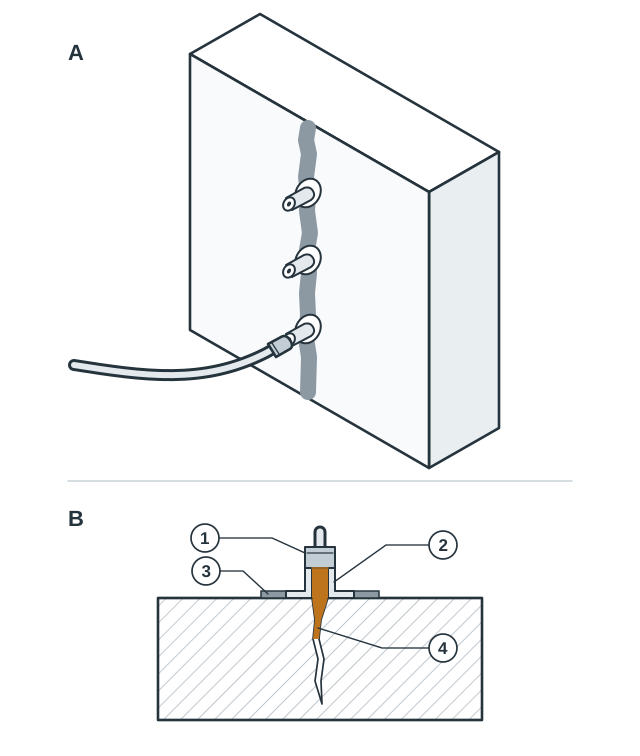 Start of epoxy injection into a vertical crack. A shows the wall, B the horizontal section through the lowest surface-mounted port.
Legend · 1. Hose and coupling · 2. Bonded injection port · 3. Surface seal · 4. Resin at the crack entrance
The repair design sets the injection pressure, port spacing and access to the crack. Product instructions and safety data sheets set out the conditions for application and safe handling.
How is the result assessed?
During the work, the team can record which ports accept material, where material appears, how much is used and whether anything deviates from the procedure. A neat seal or visible material take is an observation, not proof that the entire crack has been filled through its full depth.
Acceptance criteria belong in the repair plan or contract in advance. Depending on the purpose and structure, further checks may be needed, such as examination of cores or a suitable non-destructive method. A competent specialist should define the method, test locations and interpretation. For water control, agree how leakage will be assessed under relevant conditions. For a structural objective, the responsible engineer determines whether the intended structural result has been achieved.
What should you ask the specialist?
- What is the likely cause, and how was it established?
- Is the crack active, stable or uncertain, and what does that mean for a rigid injection?
- Is the main aim structural repair, reducing water ingress, or both?
- Which injection material and port variant have been selected, and why do they suit the moisture and crack behaviour?
- What preparation, records and checks are planned? What can those checks demonstrate, and what can they not demonstrate?
- What assessment or monitoring is needed after repair?
Also read how to identify cracks in concrete and how to choose a repair method. Find specialist contractors in the contractor directory.
Sources
- American Concrete Institute, Committee E706, Structural Crack Repair by Epoxy Injection, ACI RAP Bulletin 1, 2003, reapproved 2009, pp. 4–7 (cause and objective, moisture, cap seal, surface ports, injection procedure and checks). PDF.
- STRRES, Traitements des fissures par injection, Guide FABEM 3, version 2, November 2013, especially introduction §§1–3, 4.1–4.2, 4.5.5, 5 and 6 (objective, diagnosis, preparation, product selection and checks). PDF · guide page.
- Betonvereniging, Drie typen reparaties: esthetisch, technisch en constructief, undated knowledge-base article, accessed 10 November 2026 (distinguishing technical, water-controlling and structural repair objectives). Article.